
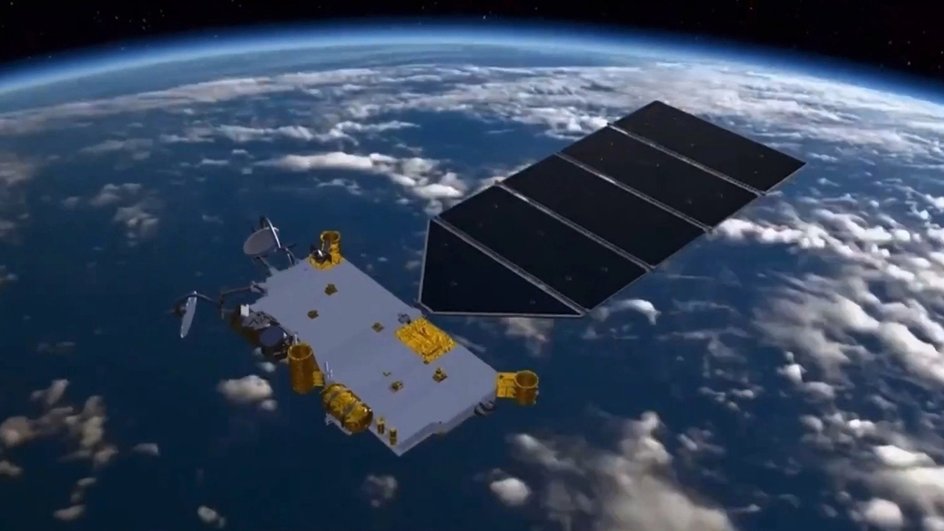
A team of Chinese experts has transitioned satellite production to an assembly line system similar to that of the automotive industry.This approach has made production faster, more efficient, and more cost-effective.When a satellite is assembled by moving from one workstation to another, from one node to the next just like a car, space ceases to be a domain reserved only for custom specimens.It becomes a fully-fledged industry.Hu Haiying and his team did not just increase assembly speed, they transformed the entire concept:satellites are no longer born in laboratories, they roll off the assembly line.This marks the beginning of a new era making access to space possible for the masses, not just a selected few.The new approach developed by Hu Haiying, director of the Innovation Academy for Microsatellites of the Chinese Academy of Sciences, and his team allows for the production of up to 300 satellites per year.Hu explained: "This is similar to a manufacturing cycle: the satellite is moved from one workstation to another. After passing through all workstations, the satellite is basically considered fully manufactured."According to Hu, the growing demand for large satellite constellations made the implementation of the conveyor model possible. "With the creation of large constellations consisting of numerous satellites, we naturally came to this idea: can this be done in the same way cars are produced on an assembly line? Such a method is much more efficient."The team overcame numerous difficulties to bring this idea to life. They had to redesign the entire process, starting from design to research and development, manufacturing, testing, as well as in-orbit operation and maintenance.Feng Jiapen, a senior engineer at the institute, said: "Director Hu is leading us in creating all technological breakthroughs from scratch. Therefore, preparing each new satellite becomes a very complex task."Hu added: "Of course, there are difficulties, but we are not afraid of them. Moving forward in previously unexplored areas and under conditions of technological uncertainty, we follow a simple principle: as party members, we must take the initiative when the country needs us and master these new areas to meet national strategic needs."As China s space program grows at a faster pace than ever, the team is ready to contribute to this growth. Hu described this as: "Our goal is to make communications accessible in even more distant regions, even at sea and in space. Thus, more people can benefit from the advantages of digital technologies."Until recently, satellite production was carried out in the form of manual assembly of individual custom specimens. Gathering each satellite required several months, and sometimes several years. The assembly line model, used for microsatellites for the first time, reduces assembly time to a few days and cuts costs several times over. This makes it possible to create giant satellite constellations for global internet, climate change monitoring, and communications. For China, which is actively developing low-orbit systems, such an approach represents a strategic advantage.